
Leesburg, GA |
The Georgia Pecan Growers Association’s Fall Field Day brought producers and researchers together in Leesburg recently for an up-close look at the challenges and management strategies shaping this year’s crop. For growers who can see the research in person — and then take it home to apply in their own orchards — events like this one carry real weight.
“Field days like this are very important because they separate how you process information from what you may read in a book or see on a screen to being able to see it visually,” said Andrew Sawyer, Southeast Area Pecan Agent with UGA Extension. “When people get out here in the orchard, they’re able to put their eyes on it — and it allows them to process that information differently. For the most part, they always respond positively.”
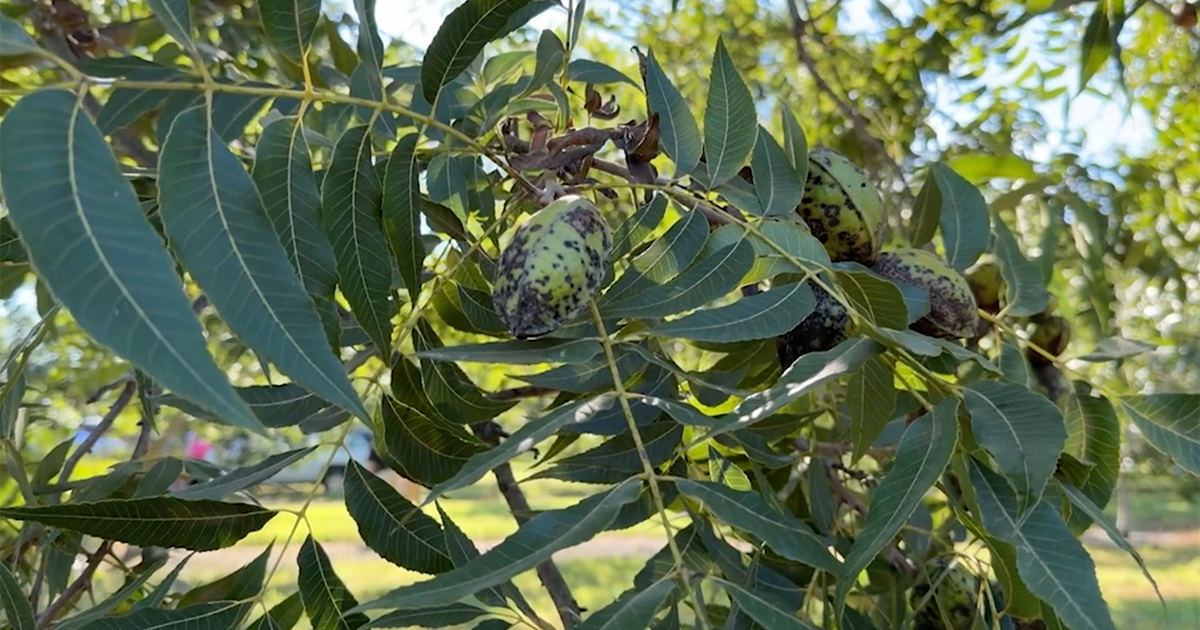
There was plenty to see this season. Lenny Wells, Extension Pecan Specialist for the University of Georgia, says heavy summer rainfall has made disease management one of the defining battles of 2026 — particularly in southwest Georgia, where scab pressure has been relentless.
“We’ve had a lot of scab pressure, especially in southwest Georgia. As you get over into East Georgia, it’s been a little drier, so they haven’t had as many of the scab issues we’ve had here,” Wells said. “But anytime we get a lot of rain like we have this summer, it makes controlling scab — which is of course our biggest problem — an even bigger challenge. Frequent rains make it hard to get out in the field to spray, and when you do get out there, a lot of times it may get washed off that afternoon. So it just keeps the scab continuously going.”
That disease pressure doesn’t just threaten yield — it hits the bottom line directly, driving up one of the most significant costs pecan growers already face.
“The cost of fungicide and applying those fungicides is one of the biggest costs we have in growing pecans. When it’s raining more often, you have to spray more often — and that drives costs way up,” Wells said. “That’s one reason we recommend trying to plant varieties that have a decent level of scab resistance, so that you don’t have to spray as often.”
On top of the scab challenge, many Georgia pecan growers are still working through the aftermath of Hurricane Helene. But Wells says the good news is that the recovery cycle is playing out about as expected — and for growers in East Georgia, this year is bringing some much-needed relief.
“Normally what we see after a hurricane or a storm like Helene is that the year after the storm, the trees have been under a great deal of stress and aren’t really going to put on much of a crop. Then the following year, they’ll put that crop on again — and it’s a pretty decent crop,” Wells said. “That’s kind of where we are in the cycle. This year, the crop in East Georgia and throughout the state looks pretty good. That’s a blessing, certainly for those guys in East Georgia who have lost so much.”
For Georgia’s pecan producers, the field day served as a timely reminder that research, variety selection, and staying connected to the work happening in the orchard are often the difference between a manageable season and a costly one.